
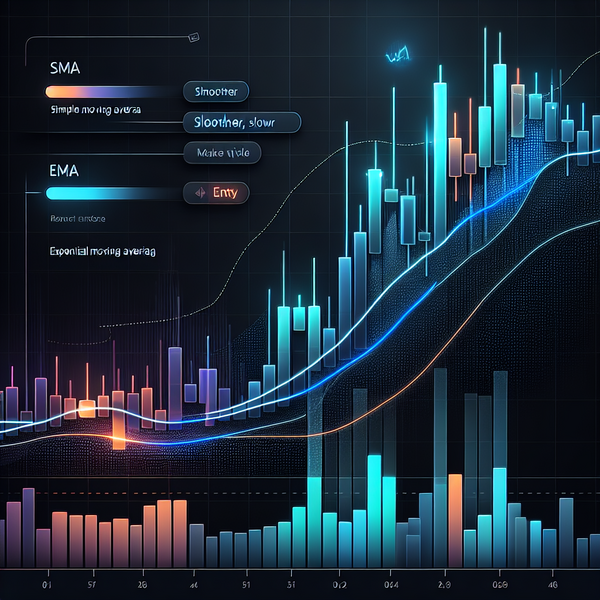
In the fast-paced world of trading, understanding how to interpret price trends can make or break your success. One of the most reliable ways to filter out market noise and identify true direction is through moving averages. Among the most popular types are the Simple Moving Average (SMA) and the Exponential Moving Average (EMA). While both aim to smooth out price fluctuations, they do so in distinct ways that can significantly impact your trading approach.
What Are Moving Averages?
Moving averages are among the most frequently used technical indicators. They serve as visual tools for tracking the average price of an asset over a specific period. By calculating an average, moving averages help traders identify the overall trend direction and potential reversal points without being distracted by daily price volatility.
Importance of Moving Averages in Trading
Moving averages are essential for:
- Recognizing the direction of the trend (uptrend, downtrend, or sideways).
- Identifying potential support and resistance levels.
- Generating trading signals based on crossovers and price interactions.
These averages simplify decision-making and help traders time their entries and exits with better precision.
Simple Moving Average (SMA) Explained
The Simple Moving Average is the most straightforward type of moving average. It calculates the average closing price of an asset over a chosen time frame. For example, a 10-day SMA adds up the closing prices of the past 10 days and divides the total by 10.
How SMA Works
- It gives equal weight to each price within the chosen period.
- This makes it stable and less sensitive to sudden price spikes or drops.
- As a result, SMA often has a slight lag compared to faster-moving averages.
This lag can be advantageous when traders prefer confirmation before reacting to price movements. However, it can also delay signals, meaning traders might enter or exit trades later than desired.
Advantages of SMA
- Simplicity: Easy to calculate and interpret, making it ideal for beginners.
- Smoothness: Filters short-term volatility effectively.
- Reliability: Provides a strong sense of long-term market direction.
Limitations of SMA
- Lagging nature: Because all data points are weighted equally, SMA reacts slowly to price changes.
- Less sensitivity: It might miss early signs of trend reversals.
Exponential Moving Average (EMA) Explained
The Exponential Moving Average takes a more advanced approach. Unlike the SMA, it gives more importance to recent prices, allowing it to react faster to new information.
How EMA Works
- EMA applies a weighting multiplier that prioritizes the most recent price data.
- This exponential weighting reduces lag and makes it more responsive to current market conditions.
- Traders often use shorter EMAs (like 10 or 20 periods) to capture quick price changes.
This responsiveness allows the EMA to catch trend shifts earlier than the SMA, though it may also produce more false signals during choppy market conditions.
Advantages of EMA
- Speed: Reacts faster to changing market dynamics.
- Relevance: Reflects current price movements more accurately.
- Versatility: Popular among short-term traders and algorithmic systems.
Limitations of EMA
- Over-sensitivity: Prone to giving false signals in sideways or low-volatility markets.
- Complexity: Requires understanding the weighting formula to interpret effectively.
SMA vs. EMA: Key Differences Explained
To understand the difference between SMA and EMA, think about speed versus stability. Both serve the same purpose—identifying trends—but the way they respond to price movements sets them apart.
Comparison Overview
- Calculation method: SMA averages all prices equally; EMA weights recent data more heavily.
- Responsiveness: EMA reacts faster to current price changes; SMA moves more slowly.
- Signal reliability: SMA reduces false alarms; EMA provides early trend detection.
For long-term trend analysis, SMA provides smoother insights. For short-term trading or scalping, EMA delivers quicker reactions.
Which Is Better: SMA or EMA?
There is no universal better option—it all depends on trading style and objectives:
- If you are a long-term investor, SMA can help filter out market noise.
- If you are an active trader, EMA might be preferable for spotting trends early.
The choice should align with your risk tolerance, time horizon, and market conditions.
Using Moving Averages in Trading Strategies
Both SMA and EMA can be used individually or together to generate trading signals and analyze momentum. The key is understanding how they interact with price and each other.
Common Moving Average Strategies
- Moving Average Crossover: When a short-term EMA crosses above a long-term SMA, it often signals a potential uptrend. The opposite crossover may indicate a downtrend.
- Dynamic Support and Resistance: Prices often bounce off moving averages, making them key reference points for entries and exits.
- Trend Confirmation: When prices remain above moving averages, the trend is likely bullish; staying below suggests a bearish pattern.
Tips for Effective Use
- Combine multiple moving averages to confirm trends from different timeframes.
- Avoid relying on moving averages alone—pair them with volume or momentum indicators.
- Adjust your period length based on market volatility and your trading style.
Optimizing SMA and EMA for Different Markets
Not all markets behave the same way. The effectiveness of a moving average can vary depending on whether you trade stocks, forex, or cryptocurrencies.
For Stocks
Stock traders frequently use longer SMAs, such as the 50-day and 200-day, to identify the health of broader trends. EMA, however, helps detect momentum shifts during shorter swings.
For Forex
In forex markets, EMAs are particularly useful because of their ability to capture fast price dynamics. A common setup is combining a 12-period and a 26-period EMA to detect entry points.
For Crypto
Cryptocurrency markets move rapidly and can benefit from EMAs due to their sensitivity. Many traders mix SMA and EMA to balance smoothness and responsiveness.
Practical Insights: Combining SMA and EMA
One practical approach is blending both averages for confirmation. For instance, a trader might use an SMA to define the broader trend and an EMA to identify precise entry points.
Example Strategy
- Use a 50-day SMA to determine the overall market direction.
- Add a 20-day EMA to capture shorter momentum shifts.
- Enter trades when the EMA crosses the SMA in the direction of the trend.
This method helps traders filter false signals and act only when both indicators align, increasing confidence in decision-making.
Common Mistakes When Using Moving Averages
Even experienced traders can misuse moving averages. Avoid these pitfalls to improve accuracy.
- Overcomplicating the chart: Using too many moving averages can cause confusion and contradicting signals.
- Ignoring market context: A moving average works best when combined with other indicators or pattern analysis.
- Not adapting to volatility: What works in a strong trend may fail in a ranging market.
Conclusion: Mastering SMA vs. EMA for Smarter Decisions
Both Simple Moving Averages and Exponential Moving Averages are powerful tools that every trader should understand. The SMA offers a clearer view of long-term trends, while the EMA reacts swiftly to current market changes. Mastering their differences enables traders to fine-tune strategies, reduce noise, and make smarter, data-driven decisions. When applied wisely, moving averages can become your most reliable partners in identifying profitable opportunities and managing risks effectively.