
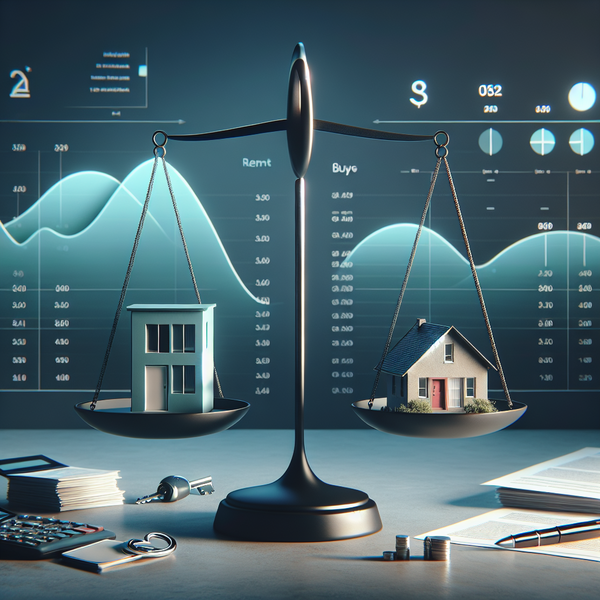
Everyone dreams of having a place to call home, but deciding whether to rent or buy isn’t just about comfort—it’s a financial puzzle. The real key lies in finding the mathematical breakeven point—that moment when buying a property becomes financially smarter than renting. Understanding this point can save you thousands and offer peace of mind in your housing choices.
Understanding the Renting vs. Buying Mathematical Breakeven Point
At its core, the breakeven point is when the total cost of owning a home equals the total cost of renting a similar one. Before that point, renting may be cheaper. After it, buying often wins. Many assume homeownership is always the better deal, but in reality, it depends on how long you stay, how much prices grow, and how costs behave over time.
Key Components of the Breakeven Calculation
Several crucial elements shape the renting vs. buying breakeven point. Understanding these allows for a realistic financial comparison:
- Home purchase price: The amount paid upfront for the property.
- Down payment: Typically 10%–20% of the home’s price, influencing initial equity.
- Mortgage interest rate: Determines monthly loan payments and lifetime cost.
- Property taxes and insurance: Annual expenses that can fluctuate over time.
- Maintenance and repairs: Usually estimated as 1% of property value per year.
- Rent growth rate: The pace at which rental prices increase annually.
- Home appreciation rate: The expected growth in your property’s value.
How to Calculate the Breakeven Between Renting and Buying
To pinpoint the breakeven, we compare the cumulative costs of renting and buying year after year until the paths intersect. This gives a clear picture of when the total ownership cost drops below the total rental expense.
Step-by-Step Calculation Method
- Estimate total buying costs. Add mortgage payments, taxes, insurance, maintenance, and subtract potential tax deductions or equity growth.
- Sum up total renting costs. Add all rent payments, adjusting for expected yearly increases.
- Compare cumulative totals. Determine the year when owning becomes cheaper than renting—that’s your breakeven point.
For instance, if your mortgage payments are high initially but your rent steadily increases, the breakeven point might be around the middle years of your mortgage term. The exact timing depends on price appreciation and cost changes over time.
Financial Variables Influencing the Breakeven Point
Even a small variation in key financial figures can dramatically shift the renting vs. buying breakeven point. Let’s explore the most influential ones.
Interest Rate Sensitivity
A lower mortgage rate means smaller monthly payments, pushing the breakeven closer. Conversely, higher interest costs delay it. Locking in favorable financing conditions can drastically improve the long-term benefits of ownership.
Property Value Appreciation
If property prices grow faster than rent, buying wins sooner. Appreciation boosts your equity and potential resale gains, while rent payments are gone forever. However, if the market stagnates, the breakeven shifts further away.
Rent Inflation and Market Dynamics
Rent tends to rise over time due to demand and inflation. Even small annual increases accumulate heavily. When rents soar, buying often becomes the more stable and predictable option.
Maintenance and Unexpected Costs
Homeownership involves expenses that renters skip: broken pipes, roofing work, or appliance replacements. Regular budgeting for such costs avoids unwelcome surprises and makes the formula accurate.
Evaluating Opportunity Cost in Renting vs. Buying
The mathematical approach isn’t complete without considering the opportunity cost of your money. The funds used for the down payment and closing costs could otherwise be invested elsewhere. If those investments outperform property appreciation, renting might make more sense financially, even beyond the breakeven point.
However, homeownership offers forced savings through principal payments—money that builds your equity every month. Over time, this disciplined saving can outweigh short-term investment gains.
Common Mistakes in Breakeven Analysis
Misjudging the renting vs. buying decision often stems from simplifying assumptions or ignoring hidden costs. Here are common pitfalls:
- Ignoring transaction fees like home inspections, legal costs, and real estate commissions.
- Assuming linear price growth regardless of market cycles.
- Failing to account for inflation’s effect on both rent and maintenance costs.
- Overlooking potential tax benefits or penalties.
Practical Ways to Estimate Your Own Breakeven Point
While broad calculators give general guidelines, a personalized approach is always best. Here’s how to get close to your true breakeven figure:
- Gather your data. Find exact figures for rent, mortgage rates, taxes, and maintenance.
- Use realistic appreciation and rent growth rates. Conservative assumptions prevent over-optimism.
- Account for occupancy length. Buying usually becomes profitable only if you stay past the breakeven period.
- Include selling costs. If you sell soon, real estate commissions and fees eat into your profits.
Emotional and Lifestyle Factors Beyond the Math
Numbers tell only part of the story. The mathematical breakeven point helps to guide financial logic, but personal circumstances matter too. Renting offers mobility, fewer responsibilities, and lower upfront costs. Buying promises stability, customization, and long-term value creation.
If you prioritize flexibility or foresee changes in work or lifestyle, renting may still be best even if breakeven occurs earlier. On the other hand, if you value predictability and plan to stay put, homeownership pays off beyond the financial equation.
Strategies to Reach Breakeven Sooner
You can influence the timing of your renting vs. buying breakeven point through smart financial planning. Consider these moves:
- Make a larger down payment. It reduces debt and interest, cutting years off the breakeven period.
- Choose a fixed mortgage rate. Locking rates protects you from payment shocks.
- Buy within your means. A sustainable mortgage helps your costs remain manageable over time.
- Negotiate repairs and warranties. These can reduce maintenance risk and total costs.
Why Breakeven Matters for Long-Term Financial Planning
Knowing when you cross the line from renting advantage to ownership benefit shapes better financial decisions. It helps plan housing transitions, savings goals, and investment portfolios. More importantly, it gives confidence in knowing your housing choice isn’t just emotional—it’s mathematically sound.
For investors, understanding breakeven timing also reveals when rental properties become profitable versus personal ownership. For families, it clarifies how long to commit before potential gains offset initial costs.
Final Thoughts on Renting vs. Buying and the Mathematical Breakeven Point
There’s no universal truth in the renting versus buying debate. The winner depends on your numbers, market conditions, and lifestyle goals. Yet, identifying your mathematical breakeven point gives a powerful lens for decision-making. It’s not about guessing the future; it’s about measuring today’s choices logically.
By analyzing costs, projecting growth, and comparing totals over time, you’ll know not just when buying makes sense—but why. In a world of uncertain prices and rates, that clarity can be your best investment.